
Infinity, Plunge, Lap or Natural: Best Pool for Bali Villas
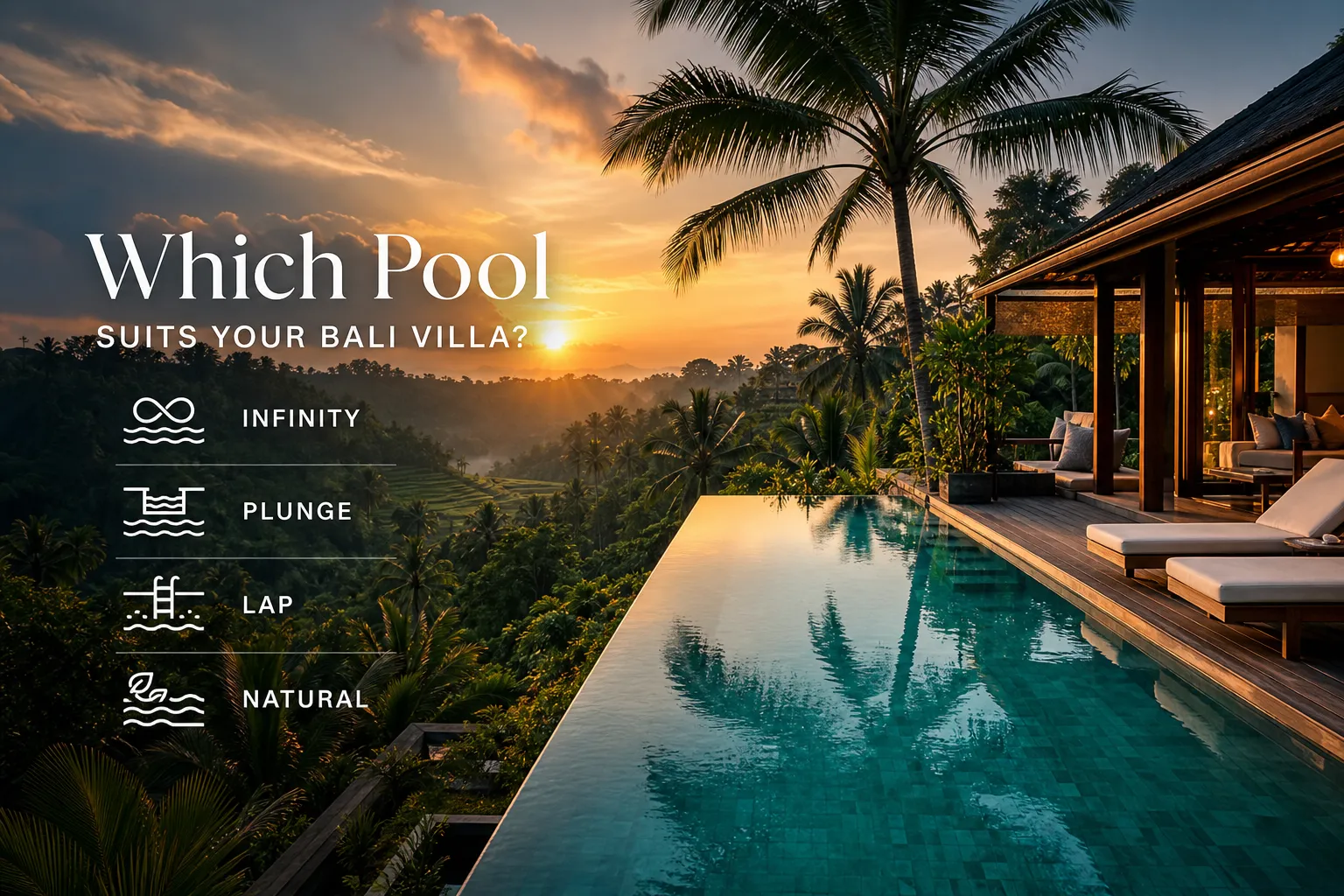
If you’re asking what is the best pool type for a Bali villa, the answer isn’t one-size-fits-all, and that’s exactly the problem most villa owners run into. The decision between an infinity pool, a plunge pool, a lap pool, or something nature-inspired carries real financial and design consequences that don’t fully surface until the bill arrives. The default approach, choosing whatever looks best in a listing photo, skips the harder questions: Does this pool suit my plot? Can I maintain it? Will my target guests actually care about it? Most Bali villas include a pool as a core amenity, and getting that choice right from the start is one of the highest-leverage decisions you’ll make.
This guide cuts through that. Drawing on 2026 Bali construction benchmarks and hands-on experience designing pools across the island, including the chlorine-free, nature-inspired work done at Bali Natural Pools, this article gives you a practical comparison you can take directly to a builder or designer. Each pool type is evaluated on five criteria: aesthetics, typical cost, minimum dimensions, maintenance load in Bali’s tropical climate, and guest appeal. By the end, you’ll know which option fits your situation, not just which one photographs well.
Why pool decisions are more consequential in Bali
Bali’s climate means your pool is in use 365 days a year. Unlike seasonal markets where a pool sits idle for months, a Bali villa pool is the central amenity, active through every guest rotation. That changes how you should weigh maintenance costs, material durability, and water system choice. A decision that looks fine on paper in a cooler climate can become an expensive operational headache under consistent tropical sun, heat, and rainfall. Bali’s conditions, specifically the rainfall, heat, and organic debris from surrounding vegetation, also accelerate algae growth and chemical drift, and this affects each pool type differently. It’s a recurring factor in every section below.
Short-term rental saturation has also shifted guest expectations significantly. South Bali Airbnb listings have grown sharply in recent years, and a generic rectangular pool no longer commands a premium nightly rate on its own. Guests now lean toward pools with character: dramatic edge views, natural aesthetics, or chlorine-free water. Understanding which category your pool falls into is the first step toward positioning your property correctly in a crowded market.
What is the best pool type for a Bali villa? A quick guide
Before diving into the detail, here’s the short version: the best pool type for a Bali villa depends on your plot size, your budget, your target guest, and how much ongoing maintenance you can realistically manage. There’s no universal winner. What follows is a type-by-type breakdown to help you match the right option to your specific situation.
Infinity pools: the view-first choice for elevated plots
Infinity pools are the signature Bali luxury feature, and for good reason. They work best on elevated sites where the overflow edge creates a visual merge with a landscape or ocean horizon. The effect is genuinely striking. But they cost more to build and maintain than any other standard pool type, and they don’t deliver the same impact on a flat urban plot.
A concrete infinity pool in Bali starts around IDR 180M for a 4x8m build and can climb past IDR 400M for custom configurations. The premium comes from the overflow edge, balance tank, and more complex hydraulics. The balance tank absorbs changes in water volume from swimmers, rain, and evaporation, keeping the overflow edge continuous. Fiberglass infinity pools exist but are structurally limited and uncommon in Bali. Use IDR 180M–400M+ as your planning range for a concrete build.
Monthly maintenance sits within IDR 600,000–1,500,000 when service and chemicals are combined, in line with other pool types at this scale. The balance tank adds one more component to inspect and clean regularly, so servicing intervals can run slightly shorter than a standard pool. On the guest appeal side, infinity pools attract romantic couples and luxury travelers who prioritize views and prestige. They photograph exceptionally well and support premium positioning on elevated or clifftop sites.
Plunge pools and lagoon-style pools: two takes on intimacy
These two pool types sit at opposite ends of the budget and footprint spectrum but share a common appeal: they feel personal and immersive rather than resort-generic. Both attract guests who book for the experience rather than for exercise.
Plunge pools: compact footprint, high guest impact
A plunge pool is the most cost-accessible option on this list. Concrete builds in Bali range from IDR 80M–150M, making them a practical entry point for smaller villa plots or tighter budgets. The minimum functional size is roughly 3.0m x 4.9m at 1.5m depth, enough for soaking and cooling, though not lap swimming. Plunge pools deliver strong ROI for couple-focused bookings, where privacy and intimacy matter more than pool size. For a compact villa in Seminyak or Canggu targeting couples or solo travelers, a well-designed plunge pool can perform better for guest satisfaction than a larger, less distinctive alternative.
Lagoon-style pools: freeform, feature-rich, and more expensive
Lagoon pools use irregular organic shapes, shallow ledges, rockwork, and landscaping to create a naturalistic feel. They’re the family-friendly option: varied depth and shallow zones suit children and groups who want to move around rather than simply float. Construction costs reflect the complexity, ranging from IDR 200M–500M+ depending on size and finish. A minimum planning footprint of approximately 3.7m x 6.1m gives the freeform shape room to read correctly, below that, the organic geometry starts to feel cramped rather than intentional.
Lap pools: the fitness-forward option
Lap pools occupy a niche, but it’s a growing one. Wellness tourism in Bali has expanded steadily, and some villa owners now specifically target guests who prioritize fitness alongside relaxation. If that’s your guest profile, a lap pool is worth serious consideration.
A lap pool needs at least 8m x 2.5m to allow a real swimming stroke, with a standard depth of 1.2–1.5m. Most practical builds run 10–12m in length. Concrete construction costs range from IDR 150M–300M for a simple rectangular build. The uncomplicated geometry keeps builder costs lower than lagoon designs despite the longer run, one of the lap pool’s underappreciated advantages.
The honest caveat: very few leisure guests specifically prioritize a lap pool over views or aesthetics. Where lap pools win is in long-stay bookings, wellness retreats, and co-living arrangements where guests want to train daily. If your villa targets health-conscious guests and pairs the pool with yoga or gym facilities, a lap pool creates a coherent offering. For general Airbnb use without that specific positioning, the ROI on the extra length is weaker than other pool types.
Natural, chlorine-free pools: the option most villa owners overlook
Natural swimming pools, also called chlorine-free or bio-filtered pools, are growing in popularity among eco-conscious villa owners in Bali and remain the least understood pool category. Most villa owners hear “natural pool” and picture a muddy pond. The reality is quite different.
Instead of chlorine, natural pools use biological filtration: beneficial bacteria, plant systems, or mineral-based water treatment to keep the water clean. The result is water that feels softer, carries no chemical smell, and doesn’t irritate skin or eyes. For wellness tourists, families with children, or guests with sensitive skin, that difference is immediately noticeable. Guest reviews across Bali villa listings frequently mention water quality as a key positive, and a natural pool’s sensory experience, soft, odor-free, chemical-free, can offer a distinct advantage that many conventional pools simply don’t replicate. It also opens a direct conversation with the growing segment of eco-conscious travelers who actively seek out chlorine-free stays.
Bali Natural Pools is one of the very few pool builders in Bali specializing exclusively in chlorine-free, nature-inspired pools. Their design approach, turning the pool itself into a feature rather than a standard amenity, shows exactly how a natural pool can justify a higher nightly rate in a saturated market. For Airbnb hosts looking to differentiate, a pool that looks and feels genuinely different is a credible way to attract repeat bookings and positive word-of-mouth.
On cost, natural pools are comparable to a well-specified conventional pool at the build stage. Monthly maintenance differs in character rather than total cost: instead of managing chlorine dosing, you manage biological system health through plant care, debris removal, and periodic water testing. In Bali’s heat and humidity, both systems need consistent attention, but chlorine-free pools eliminate the recurring chemical purchase cycle and the faint chemical odor that some guests find off-putting. Annual raw chemical spend typically runs lower for a well-maintained natural pool, though plant and ecosystem upkeep adds a different kind of hands-on time.
How to match pool type to your villa, budget, and guests
The best pool type for a Bali villa comes down to four variables: your plot size, your budget, your target guest, and your capacity to maintain the system. Here’s how those variables stack up across the five pool types covered above:
- Limited plot or tight budget: Plunge pool (IDR 80M–150M, min 3m x 4.9m)
- Elevated site with views: Infinity pool (IDR 180M–400M+, requires balance tank and hydraulic planning)
- Family or group villa with space: Lagoon-style (IDR 200M–500M+, min 3.7m x 6.1m)
- Wellness or fitness-focused positioning: Lap pool (IDR 150M–300M, min 8m x 2.5m)
- Eco, wellness, or differentiated Airbnb positioning: Natural or chlorine-free pool (comparable cost to a premium conventional pool, standout guest experience)
Guest profile is the variable most villa owners skip, and it’s the one that matters most for return on investment. Romantic couples respond to privacy and atmosphere, plunge pools and infinity pools tend to win here. Families prioritize space and safety, so lagoon-style leads. Wellness guests want an experience that feels intentional, and a natural pool paired with a private plunge setting in a quiet environment works well for that profile. Define your guest before you brief any builder. Everything else follows: the shape, the material, the filtration system, all of it flows from that one decision.
One practical note worth adding: water sourcing and permitting in Bali deserve early attention regardless of pool type. Commercial groundwater use often requires a SIPA permit, and pool projects connected to villa or rental operations are typically treated as commercial use by local authorities. Getting clarity on water supply, zoning conformity, and PBG approval before construction starts can prevent significant delays and costly design changes down the line.
The right pool is the one your guests talk about after checkout
Ultimately, when asking what is the best pool type for a Bali villa, match your plot, budget, and guest profile to the options above. An infinity pool rewards an elevated site and a luxury guest profile. A plunge pool delivers privacy and intimacy on a compact footprint. A lagoon-style pool serves families and groups who want room to move. A lap pool works for fitness-focused long stays. And a natural, chlorine-free pool offers something none of the others can: water that genuinely feels different, in a design that genuinely looks different.
For villa owners who’ve landed on a nature-inspired, chlorine-free pool as the right fit, Bali Natural Pools offers design consultations and builds exclusively in this category. The team brings focused experience designing pools that feel like natural environments rather than constructed amenities, and each project is shaped around the specific plot, guest profile, and lifestyle intent of the owner.
If you’re at the briefing stage, reach out to Bali Natural Pools before you lock in a design direction. Understanding what a chlorine-free pool actually requires on your specific site takes one conversation, and starting that conversation early is the simplest way to avoid expensive course corrections later. The best pool for your Bali villa is the one your guests are still talking about long after they check out.